
Dobereiners’s Triads
Johann Wolfgang Dobereiner was a German chemist. His effort is considered as one of the earliest attempts to classify the elements into groups.
Mario Kart Live: Home Circuit requires a Nintendo Switch or a Nintendo Switch Lite system. Browse the systems to find the right fit for you. Browse the systems to find the right fit for you. Learn more Go to Nintendo Switch page. Just make sure each player has their own Nintendo Switch system, the Mario Kart Live: Home Circuit game and a Mario kart or Luigi kart. The magic of augmented of reality doesn't just mean you'll see your course and opponents come alive on screen. Hit a boost in the game? Watch as your real-life Mario Kart speeds up. Challenge some friends. to race in the Grand Prix or try out your personalized course in a Custom Race! Just make sure each player has their own Nintendo Switch system, the Mario Kart Live: Home Circuit game, and a Mario kart or Luigi kart.  Mario Kart Live: Home Circuit is an installment in the Mario Kart series for the Nintendo Switch announced as part of the 35th anniversary of Super Mario Bros. The game makes use of physical kart products of Mario and Luigi with a camera attached to the back of the kart, which live streams the surrounding area to the player's Nintendo Switch.
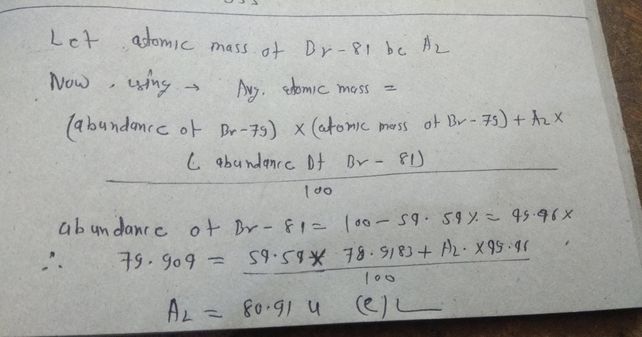
Bromine-79 atom is the stable isotope of bromine with relative atomic mass 78.918338, 50.69 atom percent natural abundance and nuclear spin 3/2. ChEBI A halogen with the atomic symbol Br, atomic number 35, and atomic weight 79.904. Atomic mass of Bromine is 79.904 u. Note that, each element may contain more isotopes, therefore this resulting atomic mass is calculated from naturally-occuring isotopes and their abundance. The unit of measure for mass is the atomic mass unit (amu). One atomic mass unit is equal to 1.66 x 10 -24 grams.

The earliest classification categorized elements into metals and non-metals. It was difficult to classify the elements, such as boron, which exhibited the properties of both metals as well as non-metals. After further research a German scientist, Dobereiner arrived at a hypothesis in the year 1829
He found that when elements are arranged into groups of three in the order of their increasing atomic mass, the atomic mass of the element; which comes in the middle; is the arithmetic mean of rest of the two. On this basis, he arranged three elements in one group which is known as ‘Triad’. This arrangement of elements is known as Dobereiner’s Triads.
Dobereiner’s Triads | ||
| Elements and their Atomic Mass | ||
| Lithium (Li) 7.0 | Sodium (Na) 23.0 | Potassium (K) 39.0 |
| Calcium (Ca) 40.0 | Strontium (Sr) 87.5 | Barium (Ba) 137.0 |
| Chlorine (Cl) 35.0 | Bromine (Br) 80.0 | Iodine (I) 127.0 |
In this table, atomic mass of sodium is equal to arithmetic mean of atomic masses of lithium and potassium. Similarly, atomic mass of strontium is equal to arithmetic mean of atomic masses of calcium and barium.
Limitation of Dobereiner’s Triads:
Dobereiner could find only three such triads (group of three elements) and he could not even put all the elements known at that time in his triads.

The rules of Dobereiner’s triads could not be applied to the elements which had very low or high atomic mass. Such as; if F, Cl and Br are put together in a triad, in increasing order of their atomic masses, the atomic mass of Cl is not an arithmetic mean of atomic masses of F and Br.
Timothee chalamet tweets. After the advancement of techniques of measuring atomic mass more correctly Dobereiner’s Law became obsolete.
Br Ka Atomic Mass
Newlands’ Law of Octaves:
Newlands found that every eighth element has similar physical and chemical properties when they are arranged in increasing order of their relative masses. This law is known as Newlands’ Law of Octaves which states that “any given element will exhibit analogues behavior to the eighth element following it in the table”. This means every eight element has the similar chemical and physical properties. Download mac os x el capitan 10.11. For example; Sodium is the eighth element from Lithium and both have similar properties.
The arrangement of elements in Newlands’ Octave resembles the musical notes. In musical notes, every eighth note produces similar sound. Because of this; Newland’s classification of elements was popularly known as just Octaves.
Limitation of Newlands’ Octaves:
Number Of Subatomic Particles In Bromine
- Newlands’ Octaves could be valid upto calcium only; as beyond calcium, elements do not obey the rules of Octaves.
- Newlands’ Octaves was valid for lighter elements only.
- It appears that Newlands did not expect the discovery of more elements than 56 which were discovered till his time.
- More than one element had to be placed in some of the groups; in order to place the elements having similar properties in one group. But in order to do so, he also put some dissimilar elements in same group.
- Iron; which has similar property as cobalt and nickel, was placed far from them.
- Cobalt and nickel were placed in the group with chlorine and fluorine in spite of having different properties.
- In spite of above limitations; Newlands was the first scientist who arranged the elements in order of their increasing relative atomic masses.